A root hair is a few hundred micrometres long. Beyond that tip lies phosphorus and nitrogen the plant will never touch on its own, locked into mineral surfaces and organic compounds that roots cannot dissolve or physically reach. The gap between what a crop needs and what its roots can access is the problem that mycorrhizal nutrient exchange solves, and it has been solving it for roughly 400 million years.
Around 80% of land plant species form this partnership with arbuscular mycorrhizal fungi. The arrangement is simple in outline and remarkably intricate in detail: the fungus extends a hyphal network far past the root zone, gathers nutrients the root could not, and delivers them directly into living root cells in return for carbon. Understanding how mycorrhizal nutrient exchange works at the cellular level changes how you read fertilizer efficiency data, how you evaluate inoculant products, and why some soils respond to biological inputs while others show nothing at all.
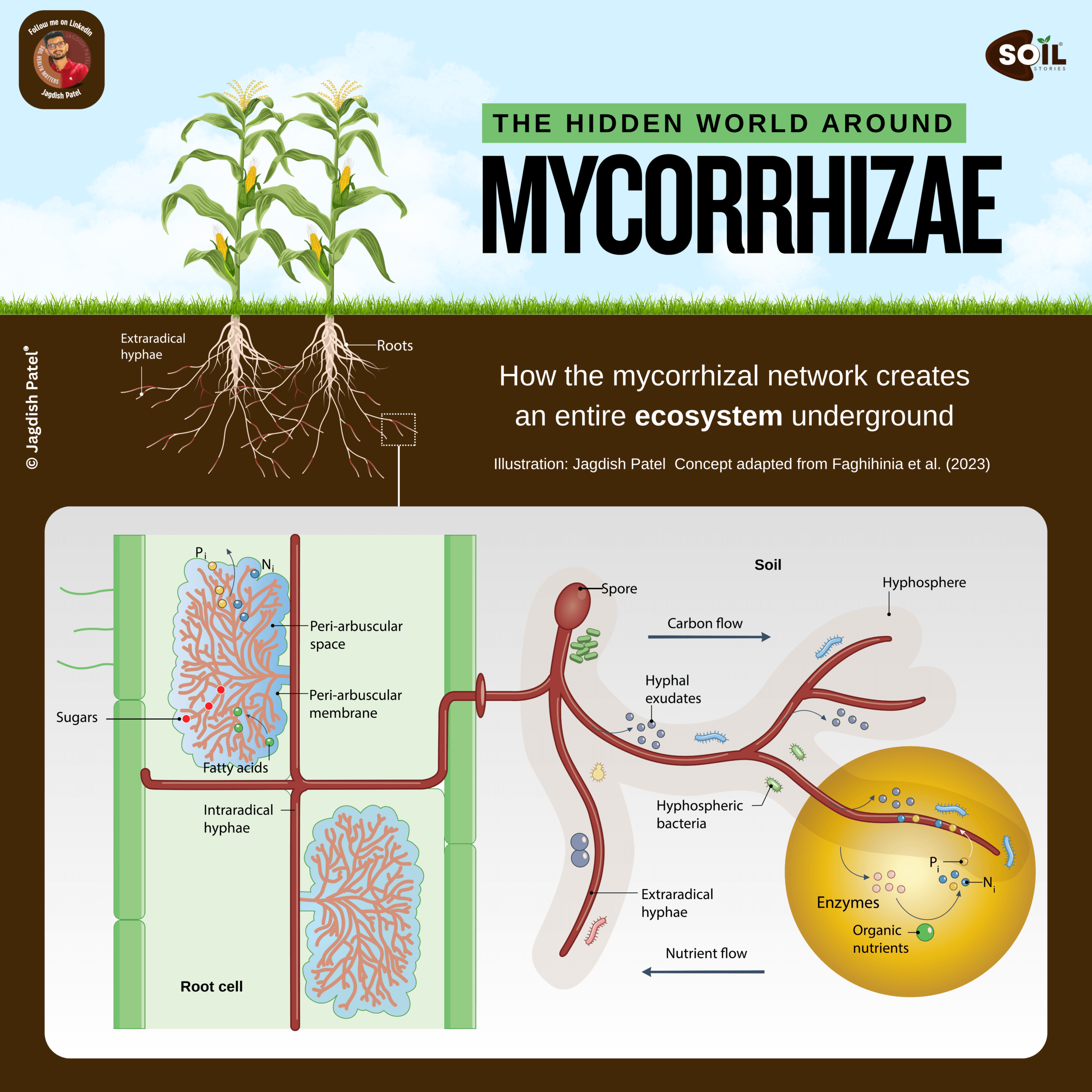
Why plant roots cannot reach most soil nutrients
Phosphorus is the clearest example of the reach problem. Phosphate ions bind tightly to soil particles and diffuse slowly, which means a depletion zone forms around every active root within days. The root keeps absorbing, the surrounding soil fails to resupply at the same rate, and the plant ends up running a phosphorus deficiency while sitting in a soil that contains plenty of phosphorus in unavailable forms.
Nitrogen creates a similar bottleneck through a different route. A large share of the soil nitrogen pool is held in organic compounds that require enzymatic breakdown before anything becomes available for root uptake, and plants do not produce the full enzymatic toolkit needed to release it. Root architecture only partly compensates, because building additional root tissue costs carbon and still confines the plant to whatever sits within a few millimetres of a root surface. Recruitment through root exudates brings microbial partners closer, but signalling alone does not extend the plant’s physical reach.
The two hyphal networks behind mycorrhizal nutrient exchange
Mycorrhizal nutrient exchange depends on two structurally distinct hyphal systems doing entirely different jobs.
Extraradical hyphae grow outward into the soil, forming a filamentous network that extends centimetres past the root surface and, in some systems, considerably further. These hyphae are an order of magnitude thinner than root hairs, which lets them enter pore spaces roots cannot penetrate and multiply absorptive surface area at a fraction of the carbon cost of new root tissue. This is the scavenging arm of the partnership, and its extent determines how much soil volume the plant effectively controls.
Intraradical hyphae do the opposite work. They grow into the root cortex, moving between and into cortical cells to establish the delivery point where nutrients cross into plant tissue. Neither network functions alone. Extraradical hyphae without an intraradical connection are simply a fungus foraging for itself, and intraradical hyphae without an extended network have nothing to deliver. Functional mycorrhizal nutrient exchange requires both halves intact and continuous.
Inside the arbuscule, where mycorrhizal nutrient exchange actually happens
Once inside a cortical cell, the hypha branches repeatedly into a structure called an arbuscule, a densely divided tree-like form that fills much of the available cell volume. The purpose of all that branching is surface area. A single arbuscule creates an enormous interface between fungus and plant inside a space measured in tens of micrometres.
The arbuscule never breaches the plant cell’s cytoplasm. The plant cell responds by wrapping it in a specialised membrane called the peri-arbuscular membrane, and the narrow gap between the fungal and plant membranes is the peri-arbuscular space. This is the actual site of mycorrhizal nutrient exchange, and the distinction matters, because the transport proteins that move nutrients across that boundary are specific to this interface and are expressed only while the symbiosis is active. The plant builds a dedicated piece of cellular machinery for this trade and dismantles it when the arbuscule collapses.
Carbon crosses from plant to fungus in two forms. Sugars move as hexoses, and lipids move as fatty acids, which is more significant than it first appears, because arbuscular mycorrhizal fungi cannot synthesise their own fatty acids and are metabolically dependent on the plant for them. Moving in the opposite direction, the fungus releases inorganic phosphate and inorganic nitrogen into the peri-arbuscular space, where plant transporters take them up and move them into circulation.
Estimates place the carbon flowing into this system at somewhere between 4% and 20% of a plant’s photosynthetically fixed carbon, depending on species, soil conditions, and fungal partner. That is a real charge against the plant’s carbon budget, and it only makes sense because the nutrients coming back would otherwise be unreachable. Mycorrhizal nutrient exchange is not generosity in either direction, and both partners can and do reduce their investment when the terms stop working.
The hyphosphere, a second economy around every fungal thread
The exchange does not begin at the root surface. Every extraradical hypha releases exudates into the thin zone of soil immediately surrounding it, known as the hyphosphere, and those exudates sustain a bacterial community measurably distinct from both bulk soil and the rhizosphere.
That community is not incidental. Arbuscular mycorrhizal fungi lack the enzymatic capacity to mineralize many organic nutrient forms directly, so they rely on hyphosphere bacteria to degrade complex organic compounds into forms the fungus can absorb. Researchers increasingly describe this microbiome as a second genome for the fungus, an outsourced set of metabolic functions the fungal genome does not encode. For the fuller picture of what this zone reveals about whether a soil is biologically active, our article on the mycorrhizal hyphosphere and living soil works through it in depth.
The complete supply chain therefore runs longer than most diagrams suggest. Hyphosphere bacteria mineralize organic matter, the fungus absorbs the released nutrients, and mycorrhizal nutrient exchange delivers them across the peri-arbuscular membrane into the root. Three organisms and one continuous supply line, with carbon paying for every step of it.
What mycorrhizal nutrient exchange means for fertilizer efficiency
High available phosphorus suppresses the symbiosis. When soluble P is abundant, plants downregulate the genes governing colonization and arbuscule formation, because the carbon price of mycorrhizal nutrient exchange stops paying for itself. In heavily fertilized systems, the fungal network thins out, and the plant reverts to direct uptake through its own root surface.
The practical consequence is uncomfortable for anyone selling inoculants into high-input systems and important for anyone managing them. Applying a mycorrhizal product to a field with a high Olsen or Bray P index is unlikely to produce a measurable response, because the plant will not invest carbon in a partnership it does not currently need. The response window opens in soils with low to moderate available phosphorus, in soils rebuilding after degradation or erosion, and in crops with coarse root systems that gain most from extended reach. Work on phosphate-solubilizing bacteria sits directly alongside this, since both mechanisms attack the same locked-phosphorus problem from different directions.
Tillage is the other decisive variable. Extraradical hyphal networks are physical infrastructure, and mechanical disturbance breaks them. A network that took most of a season to establish can be fragmented in a single pass, and the plant then pays to rebuild it from spores and residual root fragments. Reduced tillage preserves the structure that mycorrhizal nutrient exchange runs on, which is a more concrete argument for conservation practice than most soil health messaging manages to offer.
Why mycorrhizal inoculants succeed or fail in the field
Product failure in this category usually traces back to one of four things, and none of them is that the science is wrong.
Propagule viability is the first. Spores and colonized root fragments are living material with real shelf-life limits, and storage temperature, moisture, and time between manufacture and application all affect how much of the label claim survives to the furrow. The second is placement, since inoculum has to make physical contact with a developing root to initiate colonization, and broadcast application into dry surface soil rarely achieves that.
The third is the phosphorus status already described, where an agronomically sufficient soil gives the plant no reason to form arbuscules. The fourth is the resident population, because most agricultural soils already contain native arbuscular mycorrhizal fungi, and adding a commercial strain to a field with a healthy indigenous community often changes nothing measurable. Understanding these constraints is the difference between a product that gets specified again and one that quietly disappears from the programme after a season. The broader case for why crops depend on microbial partners at all is covered in our piece on why plants need microbes.
Lesser known facts about mycorrhizal nutrient exchange
Arbuscules are short-lived structures. An individual arbuscule typically persists for only a few days to around two weeks before it degenerates and the cell is recolonized, which means the exchange interface is continuously rebuilt rather than maintained. A colonized root is a construction site, not a finished structure.
The lipid dependency runs deeper than most summaries acknowledge. Arbuscular mycorrhizal fungi are obligate biotrophs partly because they cannot make their own fatty acids, and the plant supplies these through a dedicated biosynthetic pathway activated during symbiosis. This is a large part of why these fungi cannot be cultured on artificial media the way many other soil fungi can, and why manufacturing inoculum is more difficult and more expensive than producing a bacterial product.
Fungal networks also connect multiple plants. A single mycelial network can colonize several individuals at once, including plants of different species, creating shared infrastructure through which carbon and nutrients can move between hosts. How much genuinely transfers between plants under field conditions remains actively debated, and the popular framing of a cooperative underground network runs well ahead of the evidence.
Finally, the relationship is not uniformly beneficial. Colonization can reduce growth in some plant and fungus combinations, particularly where the carbon cost outweighs the nutrient return, and this is well documented rather than an anomaly. Mycorrhizal nutrient exchange is a negotiated trade with variable terms, and treating it as automatically positive leads to poor product claims and disappointed customers.
What this means for how you manage soil
The practical summary is short. Mycorrhizal nutrient exchange extends a crop’s effective root system at a lower carbon cost than growing more root, it works best where nutrients are present but poorly available, and it depends on physical hyphal networks that tillage destroys and high fertilizer rates make redundant.
If you are building a biological programme, the questions worth asking are whether the soil’s phosphorus status leaves room for the symbiosis to pay off, whether tillage practice allows a network to persist across seasons, and whether resident populations are already doing the job. Getting those three answers right matters more than the specific product on the label. The same logic applies across the wider soil biology toolkit, as covered in our overview of soil microbes and sustainable farming.
For the underlying science on how hyphosphere bacteria support fungal nutrient acquisition, the review by Faghihinia and colleagues in Biology and Fertility of Soils is the most useful entry point.

This Is the Same Clarity I Bring to Brands.
I’m a soil scientist who turned into a visual science communicator. If this article made a hard concept click, that’s exactly what I build for agriculture and AgTech brands: scientific illustrations, infographics, explainer videos, and content that turns complex research into something your customers actually understand and trust.