
Plant-microbe nitrogen cycling describes a set of natural processes happening below ground, right around crop roots, that determine how much nitrogen a plant can capture, retain, and use. While most nitrogen management conversations focus on fertilizer rates and timing, a growing body of research shows that crops and their associated microbes already have several built-in mechanisms for managing nitrogen far more efficiently than fertilizer alone.
These mechanisms are collectively known as microbiome-associated phenotypes, or MAPs: plant traits shaped by the genome but expressed through how the plant interacts with the microbial community living in and around its roots. Many of these interactions begin with root exudates, the chemical signals plants release to recruit and shape their microbial partners. The infographic below maps out five of these mechanisms and how they work together.
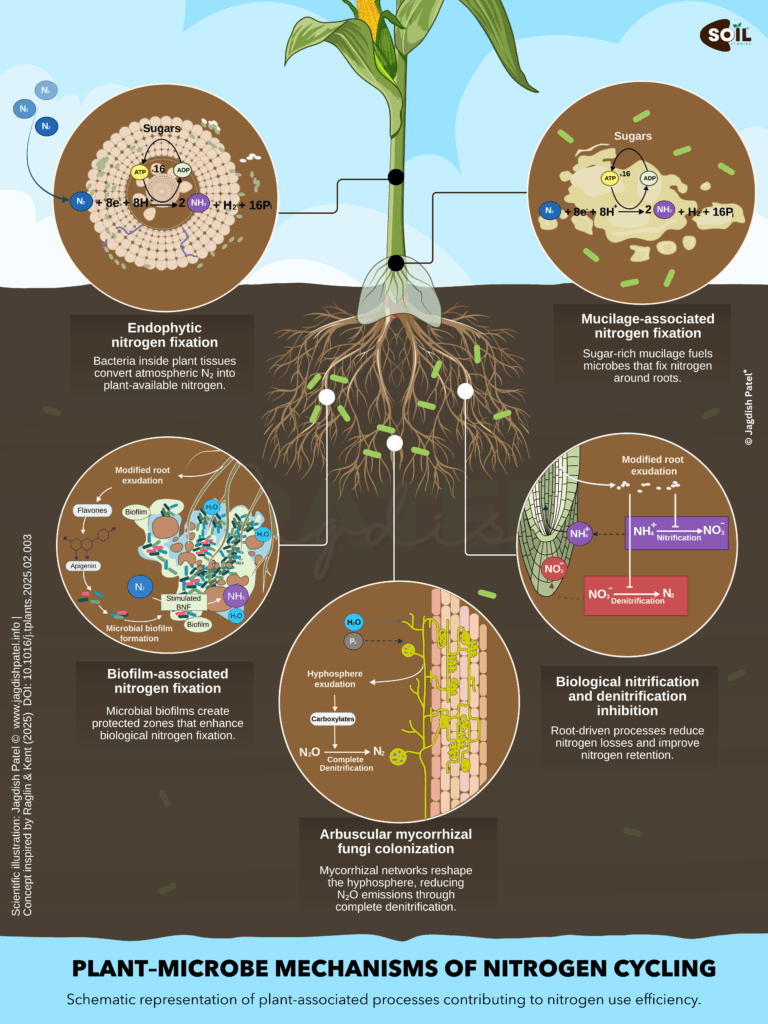
Why plant-microbe nitrogen cycling matters
When synthetic nitrogen fertilizer is applied to soil, it does not stay put. Soil microbes convert ammonium (NH4+) into nitrate (NO3-) through a process called nitrification. Nitrate is highly mobile, it leaches into groundwater, drives eutrophication in waterways, and during the conversion process releases nitrous oxide (N2O), a greenhouse gas with roughly 300 times the warming potential of CO2.
Globally, agriculture accounts for around 60% of N2O emissions, a topic explored in more depth in our look at how human activity drives soil nitrous oxide emissions. Combined with the fact that no more than half of applied fertilizer nitrogen is typically taken up by the crop, the rest is exposed to loss through leaching, volatilization, or gaseous emissions. This is the “leaky” nitrogen cycle that plant-microbe interactions can help close.
Five mechanisms shaping nitrogen cycling at the root
Mucilage-associated nitrogen fixation
Some maize landraces, most notably the Sierra Mixe variety known as olotón, release sugar-rich mucilage from aerial roots. This mucilage creates a low-oxygen environment that shelters nitrogen-fixing bacteria, and studies suggest anywhere from 25% to 80% of the nitrogen this maize accumulates can come from this source, without forming root nodules at all.
Endophytic nitrogen fixation
Certain bacteria live inside plant tissues themselves and convert atmospheric nitrogen into forms the plant can use directly. In maize, bacteria living in the stem have been shown to contribute close to 12% of stem nitrogen content. This pathway is especially relevant for perennial crops, where the same plant tissue hosts these microbial communities year after year, and it sits alongside other nutrient-provisioning roles played by phosphate-solubilizing bacteria in the broader root microbiome.
Biofilm-associated nitrogen fixation
Root-released compounds called flavones can stimulate microbes to form biofilms around roots. These biofilms reduce oxygen exposure, protecting the nitrogenase enzyme that drives biological nitrogen fixation, since nitrogenase is easily damaged by oxygen. Research using gene editing to increase flavone production in rice roots found this also increased rhizosphere biofilm formation and grain yield at the same time.
Arbuscular mycorrhizal fungi colonization
These fungi form symbiotic relationships with the roots of roughly 80% of land plants, expanding the root system’s reach into soil in exchange for plant-derived carbon. In the process, they reshape the area immediately around roots, known as the mycorrhizal hyphosphere, in ways that can reduce nitrous oxide emissions through more complete denitrification.
Biological nitrification and denitrification inhibition
Some plant roots release compounds that chemically suppress the enzymes nitrifying and denitrifying microbes depend on. Biological nitrification inhibition (BNI) slows the conversion of ammonium to nitrate, keeping nitrogen in a less mobile, more plant-available form for longer. Biological denitrification inhibition (BDI) works on the other end of the cycle, limiting the loss of nitrate as N2O or N2 gas. Both traits have been identified across grasses including maize, sorghum, wheat, and rice, and BNI has already been bred into wheat and B73 maize lines.
These traits are not always beneficial in isolation. By increasing ammonium retention in soil, BNI can, under certain conditions, increase the risk of ammonia volatilization, particularly in dryland systems. The value of any single mechanism depends on matching it to the right soil, climate, and management context.
What this means for fertilizer decisions
Taken together, these five mechanisms show that nitrogen efficiency is not just about how much fertilizer you apply or when. It is also about how much of that nitrogen the crop and its microbial partners can actually hold onto and use.
This is the practical takeaway: a field with healthy root-microbe activity, supported by organic matter, biological inputs, and reduced disturbance, may need less synthetic nitrogen to achieve the same yield, simply because less of it is being lost to leaching, volatilization, or gaseous emissions before the crop can take it up. Soil and crop management choices that protect these microbial relationships, such as minimizing excessive tillage, maintaining living roots in the soil, and avoiding practices that disrupt biofilms and mycorrhizal networks, are directly supporting the nitrogen cycle working in your favor rather than against it.
Where these traits come from
Many of the mechanisms described above are not new inventions. They are traits that were present in older crop varieties and wild relatives, and in some cases were gradually lost as breeding programs focused on other priorities like yield under high-input conditions.
The mucilage-associated nitrogen fixation seen in the olotón maize landrace is a good example. This trait has been present in traditional Mexican maize varieties for generations, but research has found that the genetic factors supporting high mucilage production were largely absent from the modern varieties grown in most commercial maize production today. Similarly, when researchers surveyed a large collection of landrace maize lines for biological nitrification inhibition capacity, only a small fraction showed strong activity, suggesting this trait is also unevenly distributed across maize genetics.
This matters for two reasons. First, it means these traits are not exotic or experimental, they exist in nature and have been selected against, often unintentionally, rather than selected for. Second, it means there is a real opportunity in breeding programs and seed selection to bring these traits back into modern germplasm, provided the genetic diversity is conserved and accessible.
For farmers, this connects to a broader point about seed choice and crop genetics. As more breeding programs begin to incorporate microbiome-associated traits, the varieties available to growers may increasingly differ not just in yield potential or disease resistance, but in how efficiently they partner with soil microbes to acquire and retain nitrogen. Asking seed suppliers about nitrogen-use efficiency traits, and not just yield numbers, may become a more common and useful part of variety selection in the years ahead.
The bigger shift
The Green Revolution gave agriculture synthetic nitrogen fertilizer and high-yielding varieties, and crop yields increased dramatically as a result. But that same shift also reduced how much modern crop varieties rely on, or even retain the genetic capacity for, microbiome-driven nitrogen acquisition.
Plant-microbe nitrogen cycling research suggests a path back toward microbiome-informed management, not as a rejection of modern agriculture’s gains, but as a way to make those gains more sustainable. Traits and practices that work with the soil’s natural microbial activity, rather than against it, may turn out to be one of the more practical tools available for reducing nitrogen losses without sacrificing yield.
This is closely related to how mycoparasitic fungi like Trichoderma interact with soil systems, covered in our Trichoderma mycoparasitism article, another example of how microbial activity in the rhizosphere directly shapes crop performance and nutrient cycling.
This article draws on findings discussed in Navigating nitrogen sustainability with microbiome-associated phenotypes, published in Trends in Plant Science (2025).

This Is the Same Clarity I Bring to Brands.
I’m a soil scientist who turned into a visual science communicator. If this article made a hard concept click, that’s exactly what I build for agriculture and AgTech brands: scientific illustrations, infographics, explainer videos, and content that turns complex research into something your customers actually understand and trust.