Trichoderma mycoparasitism is the mechanism that most BioAg labels never explain, and most growers never see. Walk into any agri-input store or read any product brochure, and you will find the same two words used to describe Trichoderma: “beneficial fungus.” It is accurate, but almost completely useless as an explanation. As a soil scientist who has personally observed Trichoderma mycoparasitism under the microscope during microbial isolation work, I can tell you that watching one fungus physically coil around and destroy another changes everything about how you understand biological disease control. This article breaks down exactly what happens at the hyphal level, why it is fundamentally different from chemical fungicides, and why that distinction matters for growers, agronomists, and BioAg companies.
What Trichoderma is actually doing in your soil
Trichoderma is a genus of free-living fungi found naturally in virtually every agricultural soil on earth, and multiple species are used in commercial biocontrol products, including T. harzianum, T. viride, T. asperellum, and T. atroviride. Its well-documented effects include colonizing plant roots and the surrounding rhizosphere, competing with soil pathogens for space and nutrients, producing secondary metabolites that inhibit fungal and bacterial pathogens, triggering induced systemic resistance (ISR) in host plants, and promoting root growth alongside improved nutrient uptake.
A comprehensive 2022 review in the International Journal of Molecular Sciences covers the full breadth of Trichoderma‘s mechanisms and commercial application in agriculture, and the depth of evidence behind it is significant. But there is one mechanism that is arguably the most powerful, and also the least explained in commercial settings, which is mycoparasitism: a direct, physical, predatory interaction where Trichoderma targets, coils around, and destroys a pathogenic fungus. It is not passive. It is not simply competitive exclusion. It is active biological attack, and understanding it changes how you evaluate every biological disease management decision you make.
The Trichoderma mycoparasitism: What happens step by step
Detection and the chemotropic response
The mycoparasitism process begins before any physical contact occurs. Trichoderma hyphae navigate the soil environment guided by chemical signals, and when a pathogenic fungus is nearby, the Trichoderma detects volatile compounds and diffusible metabolites released from the pathogen’s cell wall. This chemotropic response actively directs Trichoderma hyphae toward the target, meaning it essentially senses the enemy before it reaches it. This chemical signaling stage is why rhizosphere conditions, including soil moisture, temperature, and organic matter content, directly influence how effectively Trichoderma locates and responds to pathogens.
Surface recognition and compatible interaction
Once Trichoderma hyphae reach the pathogen hypha, a recognition event occurs at the cell surface. Lectins and carbohydrate-binding proteins on the Trichoderma surface interact with the pathogen’s cell wall components, confirming a compatible target before committing to the attack. This specificity is important, because it helps explain why different Trichoderma species have different host ranges and varying efficacy against specific pathogens. Not every Trichoderma product is equivalent, and not every strain performs identically against every pathogen, which is something that matters when you are evaluating products for a specific disease pressure in a specific crop system.
Tight coiling action
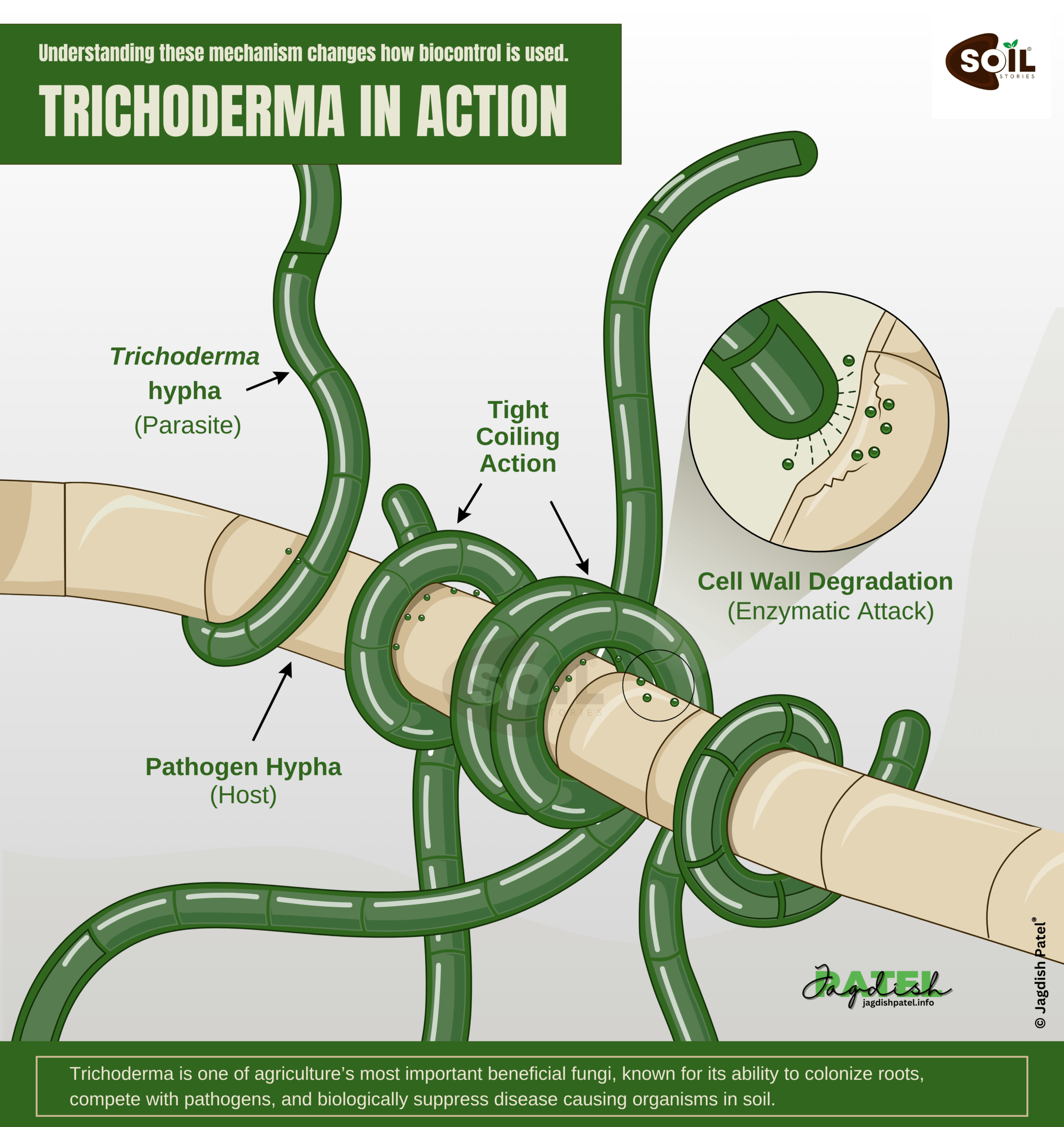
This is the step that is visually unmistakable under the microscope. Trichoderma hyphae begin coiling tightly around the pathogen hypha, loop by loop, creating a physical grip that is coordinated, progressive, and clearly directional. For anyone who has observed this directly in laboratory work, it is one of the most striking things visible under a standard light microscope in a soil microbiology setting. The coiling is not incidental contact. It is a deliberate mechanical securing of the target before the enzymatic phase begins.
Enzymatic breakdown and cell wall degradation
With the pathogen physically secured, Trichoderma begins secreting cell wall degrading enzymes (CWDEs) directly at the point of contact. These include chitinases, which degrade chitin, the structural polymer in fungal cell walls; glucanases, which break down beta-1,3-glucans; proteases, which attack cell wall proteins; and cellulases where applicable. The enzymes are released in a localized, concentrated manner at the contact zone rather than diffusely throughout the soil.
The pathogen cell wall is broken down from the outside in, the pathogen’s cytoplasm leaks, the hypha collapses, and Trichoderma absorbs the released nutrients. The pathogen is not simply outcompeted for space or nutrition. It is physically and biologically dismantled, and understanding that distinction is where biocontrol stops being vague and becomes genuinely useful.
Why this is fundamentally different from chemical fungicides
Understanding mycoparasitism immediately clarifies one of the most common frustrations with biological products: inconsistent field performance relative to chemical alternatives. That frustration usually comes from a category error, not from a product failure. Chemical fungicides work through direct toxicity. A systemic fungicide like azoxystrobin, for example, inhibits mitochondrial respiration in fungal cells, and once it reaches the target pathogen at sufficient concentration, the effect is fast and dose-dependent.
Soil conditions, biological context, and timing matter far less when the mechanism is purely chemical. Trichoderma, by contrast, works as a living biological system. Before mycoparasitism can occur, it needs to germinate from a spore or propagule, establish in the rhizosphere, build hyphal networks through the soil matrix, encounter and recognize the target pathogen, and then execute the coiling and enzymatic attack. Each of those steps is influenced by soil temperature, moisture, pH, organic matter content, microbial competition, and the timing of application relative to when pathogen pressure builds.
This is why biological products demand a different framework for evaluation. They require application at the right growth stage, ideally before pathogen pressure builds rather than as a crisis response; adequate soil moisture and temperature for germination and colonization; and compatibility checks with other inputs, because some fungicides and synthetic fertilizers suppress Trichoderma populations. Biocontrol is not magic. It is mechanism-driven biology that consistently rewards growers and agronomists who understand how the organism functions. If you want to understand the broader biological system that makes this possible, the article on how soil microbes feed your plants provides useful context on why a living, biologically active soil creates the conditions for organisms like Trichoderma to work.
Other mechanisms operating alongside mycoparasitism
Mycoparasitism is one of several mechanisms by which Trichoderma suppresses disease, and in an established rhizosphere population, multiple mechanisms operate simultaneously rather than in sequence. Antibiosis involves the production of secondary metabolites directly toxic to pathogens, including trichothecenes, peptaibols, and polyketides. Competition for space and nutrition involves occupying colonization sites and consuming available carbon and nitrogen before pathogens can establish. Induced systemic resistance (ISR) involves Trichoderma priming the plant’s own immune signaling pathways so that when a pathogen challenge does arrive, the plant responds faster and more effectively.
There is also ongoing rhizosphere engineering, where Trichoderma modifies the surrounding microbial community to shift the balance toward beneficial organisms over time. Understanding how these mechanisms interact with one another also connects directly to the concept explored in the article on rebuilding soil memory and soil health, because a soil with intact biological history tends to support more robust and consistent biocontrol outcomes than a degraded or fumigated soil starting from near-zero microbial diversity.
Mycoparasitism remains the mechanism that, when clearly visualized, most changes how people understand the product. It is the step where Trichoderma stops being a vague concept and becomes something observable, real, and mechanistically explicable.
What this means for agronomists making disease management decisions
For agronomists integrating Trichoderma into disease management programs, the practical implications of understanding mycoparasitism are specific and actionable. Timing matters more than with chemical fungicides because Trichoderma needs time to establish and locate pathogens before pressure peaks. Soil condition management, including maintaining adequate moisture, organic matter, and avoiding broad-spectrum fungicide applications close to Trichoderma inoculation, directly affects efficacy.
Product selection based on the specific species and strain, rather than treating all Trichoderma products as interchangeable, becomes more justifiable when you understand that the recognition step during mycoparasitism is pathogen-specific. And realistic performance expectations, grounded in how a living system colonizes and responds over time rather than how a chemical acts within hours, lead to far better evaluation of what the product is actually doing.
The mycorrhizal network article on this site also touches on related bacterial movement dynamics that are worth reading alongside this, as the mycorrhizal hyphosphere piece illustrates how interconnected fungal and bacterial activity in the rhizosphere actually is. The soil biological environment is not a collection of isolated organisms; it is a network, and understanding how one part of it functions improves decisions about every other part.
What this means for BioAg companies communicating their science
For companies developing or selling Trichoderma-based products, the commercial implication of mechanism-level understanding is direct. Agronomists and growers who understand what mycoparasitism actually is tend to use the product better, apply it under more appropriate conditions, and get more consistent results. The failure mode for many biological products in the market is not efficacy in trials; it is communication in the field. Products that perform well under controlled conditions underperform in the field because the end user expected chemical-speed results from a biological system, and nobody explained the difference clearly before application decisions were made.
Visuals like the mycoparasitism illustration above exist precisely to close that gap. Your sales team can explain how Trichoderma works in a one-hour grower meeting using text and diagrams pulled from a scientific paper. Or a single scientifically accurate illustration communicates tight coiling action, enzymatic degradation at the contact point, and physical neutralization of the pathogen hypha in under ten seconds of visual processing. That is not a small difference in communication efficiency; it is the difference between a grower who understands the product and one who sees it as interchangeable with the next biological on the shelf.
For BioAg companies thinking about how visual communication fits into product education and sales support, the article on organic matter versus organic fertilizer is a good example of how mechanism-level explanation also builds credibility around soil biology concepts more broadly, which ultimately supports the whole category rather than just a single product.
A note on how this illustration was made
The image at the top of this article was not AI generated. It was developed through detailed scientific research, reference gathering, multiple rounds of sketching, and iterative refinement to accurately represent what happens at the hyphal interface during mycoparasitism.
Every element, including the coiling morphology, the contact zone geometry, and the enzyme release points, reflects documented biological behavior from peer-reviewed literature. Accurate scientific illustration serves a specific purpose that generic stock images and AI-generated visuals cannot: it communicates real mechanism, not approximation. In soil science and biocontrol, that distinction matters, because inaccurate visuals build wrong mental models, and wrong mental models lead to poor decisions about product use, timing, and integration.
Biological products become easier to trust when people can actually see the science behind them.

This Is the Same Clarity I Bring to Brands.
I’m a soil scientist who turned into a visual science communicator. If this article made a hard concept click, that’s exactly what I build for agriculture and AgTech brands: scientific illustrations, infographics, explainer videos, and content that turns complex research into something your customers actually understand and trust.