
For decades, the standard explanation for how plants absorb nutrients was simple: roots take up dissolved minerals from soil water, and mycorrhizal fungi extend that reach a little further. It is a tidy picture, but it is incomplete. A growing body of research, led by microbiologist James White and his team at Rutgers University, has revealed a far more active process called the rhizophagy cycle, where plants do not just absorb nutrients passively. They cultivate microbes, extract nutrients from inside them, and send the survivors back out to do it again. This is not a rare or exotic mechanism either. It appears to operate in most, if not all, plant species, and it changes how we should think about soil biology, biofertilizer performance, and root health.
What is the rhizophagy cycle
The word rhizophagy means “root eating,” and that is a literal description of what happens. Plants recruit beneficial bacteria and fungi into their roots, partially digest them using oxidative stress, absorb the nutrients released in the process, and then expel the surviving microbes back into the soil through root hair tips. Those microbes recover, multiply, gather more nutrients, and re-enter the root. The cycle repeats continuously as long as the root tip is growing.
This reframes the plant root not as a passive filter but as an active farming system. The microbes are not simply symbiotic passengers, they are a renewable nutrient source that the plant manages on a loop, much like the mycorrhizal hyphosphere manages bacterial traffic along fungal networks. Both systems point to the same conclusion: soil biology is not a backdrop to plant nutrition, it is the engine of it.
The five stages of the rhizophagy cycle
Stage 1: Microbes gather around the root
Roots release exudates, sugars, amino acids, and organic acids, into the surrounding soil. These exudates act as a chemical invitation, drawing beneficial bacteria and fungi into the rhizosphere, the thin zone of soil directly influenced by root activity. This is the plant setting the table before the meal. Root exudation is not a passive leak either, plants regulate the volume and composition of exudates depending on their nutrient status, effectively adjusting how strongly they recruit microbial help.
Stage 2: Microbes collect nutrients from the soil
Once in the rhizosphere, microbes do what microbes do best: they scavenge. They move through the soil absorbing nitrogen, phosphorus, iron, zinc, magnesium, and other elements, concentrating these nutrients inside their own cells. In effect, the microbes act as mobile nutrient collectors, gathering resources the plant root alone could not reach or access as efficiently. This is one reason active soil biology matters more than raw nutrient concentration on a soil test. A soil can be nutrient rich on paper and still underperform if the microbial workforce required to mobilize and deliver those nutrients is weak or dormant.
Stage 3: Microbes enter the root
Near the root tip and along developing root hairs, microbes move into the root itself. They enter through natural openings or by stimulating their own uptake mechanisms, migrating into the root epidermal cells where the next stage takes place. This entry point is tightly localized to actively growing root tissue, which is part of why root health and continuous new root growth are so central to how efficiently this cycle runs.
Stage 4: Nutrient extraction inside root cells
This is the stage that separates rhizophagy from ordinary symbiosis. Inside the root cell, the plant generates reactive oxygen species, or ROS, that partially degrade the cell walls of the microbes it has just hosted. This oxidative stress does not necessarily kill the microbe outright, but it is enough to rupture the cell wall and release the nitrogen, phosphorus, iron, zinc, and magnesium the microbe had collected. The plant absorbs these nutrients directly into its own cellular machinery. This controlled use of oxidative stress is a striking example of how plants deploy tools normally associated with defense, ROS is also part of the immune response against pathogens, for an entirely constructive purpose: nutrient harvesting.
Stage 5: Surviving microbes exit through root hairs
Not every microbe is destroyed in stage four. Survivors are expelled from the tips of growing root hairs back into the surrounding soil, where they recover, multiply, and begin collecting nutrients again. This is what makes the process a true cycle rather than a one-time event. As long as the root tip continues to grow, the loop continues, generation after generation of the same microbial lineage cycling in and out of the plant.
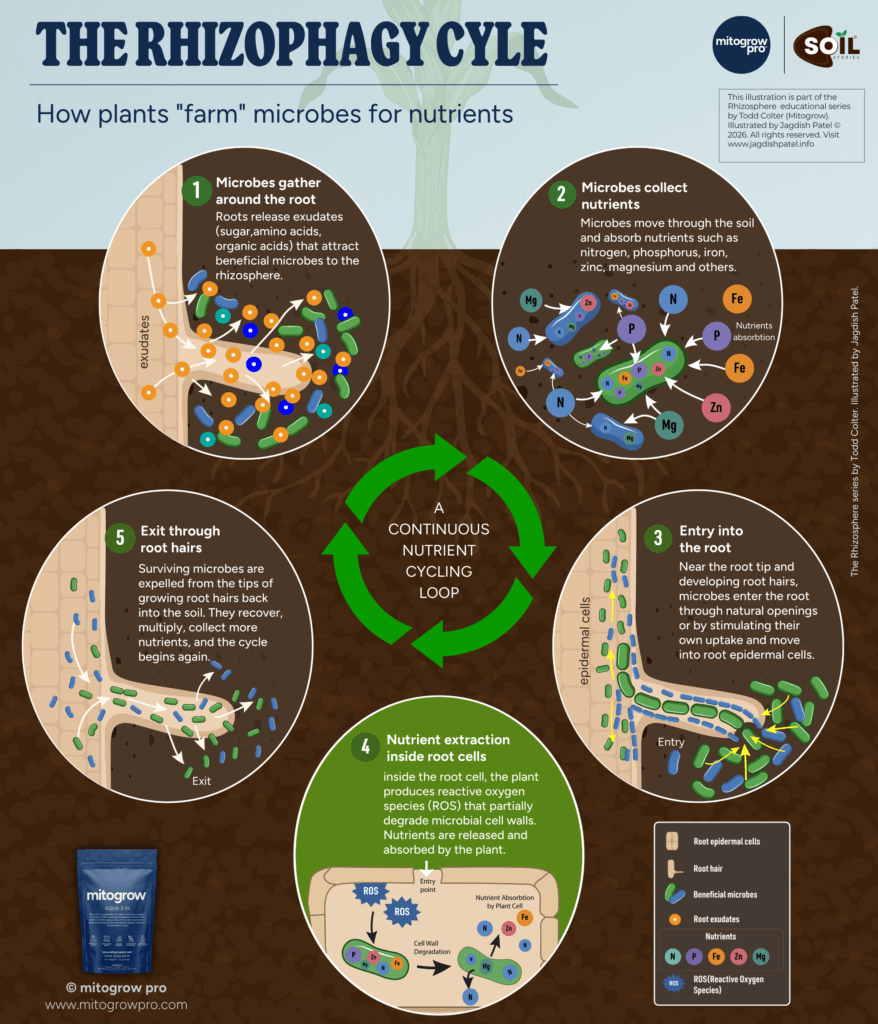
This illustration was created by Soil Stories for Mitogrow Pro. As a content partner, our work goes beyond product promotion, we translate the underlying science so your audience actually understands what they are buying and why it works. If you need visual content that builds credibility with a technical audience, let’s connect.
Why the rhizophagy cycle matters for soil health and crop nutrition
Understanding this cycle has practical consequences for anyone working with soil biology, whether in research, biofertilizer development, or field agronomy. It explains why microbial inoculants and biostimulants can improve nutrient uptake even when soil nutrient levels look adequate on a lab report. The bottleneck is not always availability, it is the efficiency of the biological transfer mechanism from soil to root. A product that introduces beneficial strains without supporting their survival, movement, and re-entry into the root is only solving part of the problem.
It also reframes what a healthy rhizosphere actually needs. A thriving population of beneficial microbes is not just a source of disease suppression or hormone signaling, it is an active nutrient delivery system that depends on continuous root growth, healthy exudate production, and a soil environment that supports microbial recovery between cycles. This is the same principle explored in the broader idea of living soil as a bond between soil, organic matter, and organisms, where fertility is treated as a property of the whole system rather than a single input. Compacted soil, low organic matter, or aggressive tillage can all interrupt the rhizophagy loop, not just by killing microbes, but by disrupting the root hair growth that the entire cycle depends on.
For agronomists and farmers working with biological products, this mechanism is worth understanding before evaluating whether a product is working. Nutrient uptake through rhizophagy is continuous and cyclical, not a single event, so field results often depend on giving the biology time to establish the loop rather than expecting immediate uptake after a single application. It also explains why consistent, season-long biological support tends to outperform one-time inoculation, the cycle needs healthy root tips and a stable microbial population to keep running.
What this means for biofertilizer and biostimulant strategy
Companies developing microbial inputs are, whether they frame it this way or not, designing products meant to plug into this cycle. Strain selection matters because not every microbe survives the stage four extraction process equally well or delivers a useful nutrient payload when it does. Formulation matters because the microbes need to reach the rhizosphere alive and active enough to complete stage one and two before entry is even possible. And field timing matters because the cycle depends on active root growth, which means application windows tied to root flush stages will generally outperform a single blanket application at planting.
This is also where the marketing challenge for biological companies becomes clear. The rhizophagy cycle is genuinely more interesting, and more scientifically defensible, than vague claims about “boosting soil life.” Explaining the actual mechanism, not just the outcome, is what builds trust with agronomists and technically literate buyers who are used to being oversold.
The bigger picture
The rhizophagy cycle is still an active area of research, and there is more to learn about how it varies across plant species, soil types, and microbial strains. What is already clear is that plants are far more active participants in their own nutrition than the old picture of passive mineral absorption ever suggested. Roots recruit, extract, and release microbes in a continuous loop, and every stage of that loop depends on the health of the surrounding soil biology. Understanding this mechanism gives agronomists, researchers, and biological product developers a more accurate model to work from, and it gives farmers a clearer reason to protect the living systems already working beneath their feet.

This Is the Same Clarity I Bring to Brands.
I’m a soil scientist who turned into a visual science communicator. If this article made a hard concept click, that’s exactly what I build for agriculture and AgTech brands: scientific illustrations, infographics, explainer videos, and content that turns complex research into something your customers actually understand and trust.