Modern farming is drowning in complexity. We obsess over NPK ratios, chase new fertilizer blends, and invest heavily in inputs that promise higher yields. Yet, from years of working at the intersection of soil analysis, biological processes, and farm-level decision making, it becomes clear in my work that two indicators quietly control nutrient efficiency more than any fertilizer program: Electrical Conductivity (EC) and Cation Exchange Capacity (CEC).
Soil test reports often look perfect on paper, yet crops struggle in the field. In most cases, the issue is not the fertilizer itself, but how the soil handles nutrients once they are applied. EC and CEC govern that process. They decide whether nutrients remain available, become locked, or are lost altogether.
These are not just laboratory numbers. EC and CEC shape water movement, nutrient stability, root access, and biological activity. When balanced, they turn soil into a reliable nutrient engine. When mismanaged, they quietly erode yield potential and profitability.
What Is Electrical Conductivity (EC)? The Nutrient Highway
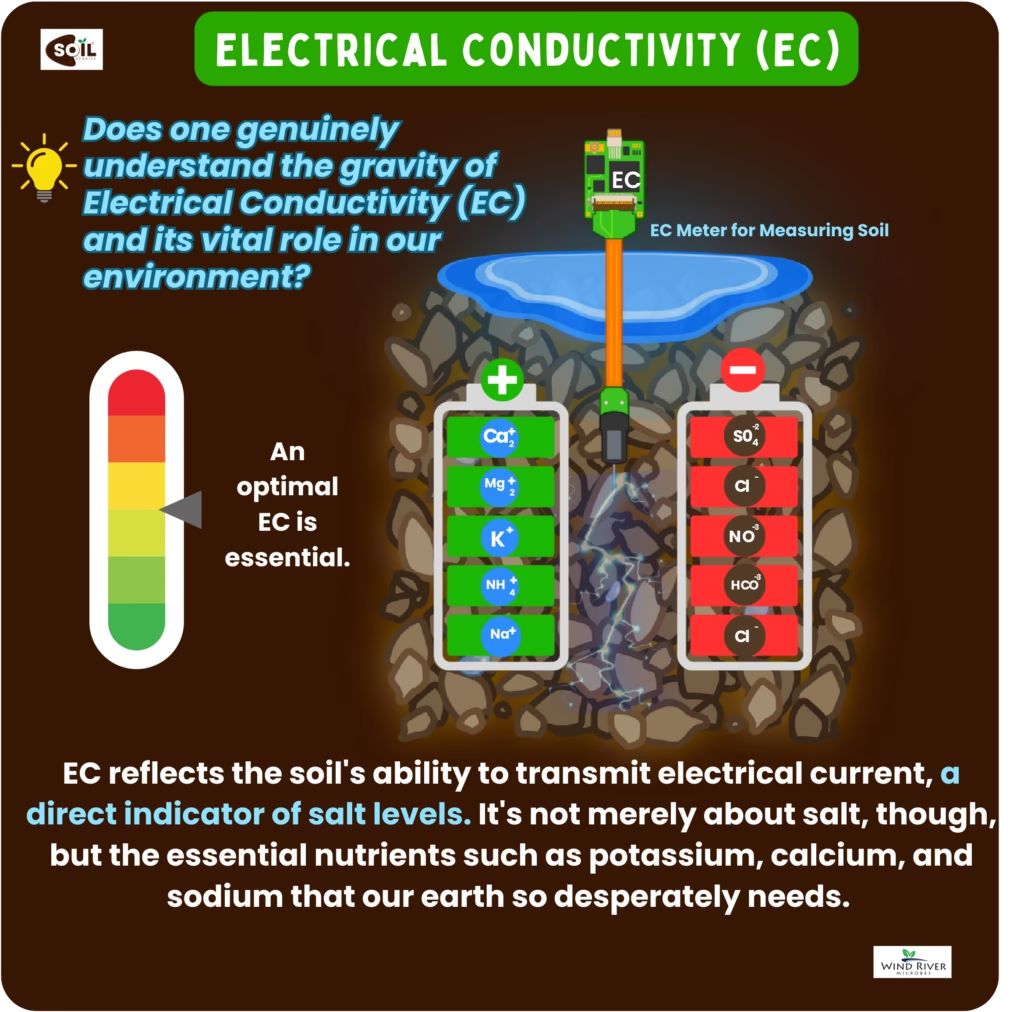
Electrical Conductivity (EC) measures the soil’s ability to conduct electrical current. In practical terms, it reflects the concentration of dissolved salts and nutrients in the soil solution, the water phase from which plant roots absorb nutrients.
EC tells us how concentrated this nutrient solution is. Too low, and plants struggle to find nutrients. Too high, and roots struggle to take up water.
Most essential plant nutrients carry an electrical charge, including calcium (Ca²⁺), magnesium (Mg²⁺), potassium (K⁺), ammonium (NH₄⁺), nitrate (NO₃⁻), and sulfate (SO₄²⁻).
Typical EC Ranges and Crop Response
| EC Range (mS/cm) | Soil Condition | Impact on Crops |
|---|---|---|
| < 0.8 | Very low EC | Poor nutrient availability |
| 0.8 – 2.0 | Optimal EC | Efficient uptake and balanced growth |
| 2.0 – 4.0 | High EC | Reduced uptake, early stress symptoms |
| > 4.0 | Excessive EC | Salt stress, root damage, yield loss |
EC responds quickly to fertilization, irrigation, rainfall, and drainage. That makes it a powerful real-time indicator, but also a risky one if interpreted without context.
Why High EC Often Reduces Yield
High EC is one of the most common yet misunderstood stress factors in intensive agriculture.
When EC becomes excessive:
- Roots experience osmotic stress and struggle to absorb water
- Root tips are damaged by concentrated salts
- Nutrients compete with each other, creating imbalances
- Beneficial soil microbes slow down or become inactive
- Crops show deficiency symptoms despite high nutrient levels
This often leads to a damaging cycle. Poor growth is mistaken for nutrient shortage, more fertilizer is applied, EC increases further, and crop performance declines even more.
High EC does not indicate high fertility. It often signals restricted access.
What Is Cation Exchange Capacity (CEC)? Your Soil’s Nutrient Storage System
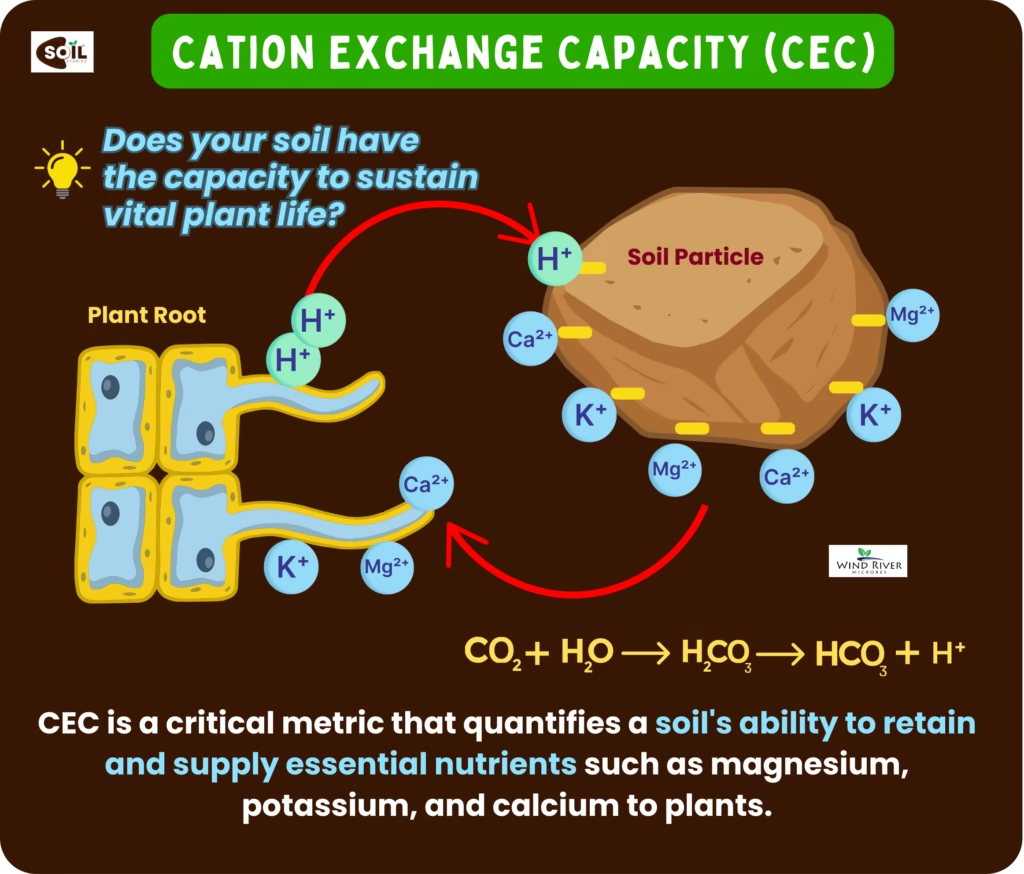
While EC measures nutrients in motion, Cation Exchange Capacity (CEC) measures nutrients in reserve.
CEC describes how many positively charged nutrients a soil can hold on clay and organic matter surfaces and release gradually to plant roots. It reflects the soil’s ability to buffer nutrients against leaching and supply them steadily over time.
Typical CEC Values by Soil Type
| Soil Type | CEC (meq/100g) | Nutrient Holding Capacity |
|---|---|---|
| Sandy soil | 2 – 5 | Very low, high leaching risk |
| Sandy loam | 5 – 10 | Low to moderate |
| Loam | 10 – 20 | Balanced and stable |
| Clay soil | 20 – 40 | High nutrient storage |
| Organic-rich soil | 25 – 60 | Very high buffering and retention |
CEC changes slowly. Unlike EC, it reflects long-term soil condition rather than short-term management.
How Roots Unlock Nutrients Stored by CEC
CEC is not passive storage. It is an active exchange process driven by plant roots and soil biology.
Roots release hydrogen ions and organic acids into the surrounding soil. These compounds displace calcium, magnesium, potassium, and ammonium from soil particles, allowing roots to absorb them. Microbial activity enhances this process by accelerating nutrient cycling and mineralization.
This is why soils with high CEC can still show nutrient deficiencies if biological activity is weak. Stored nutrients must be biologically unlocked to become available.
How EC and CEC Work Together
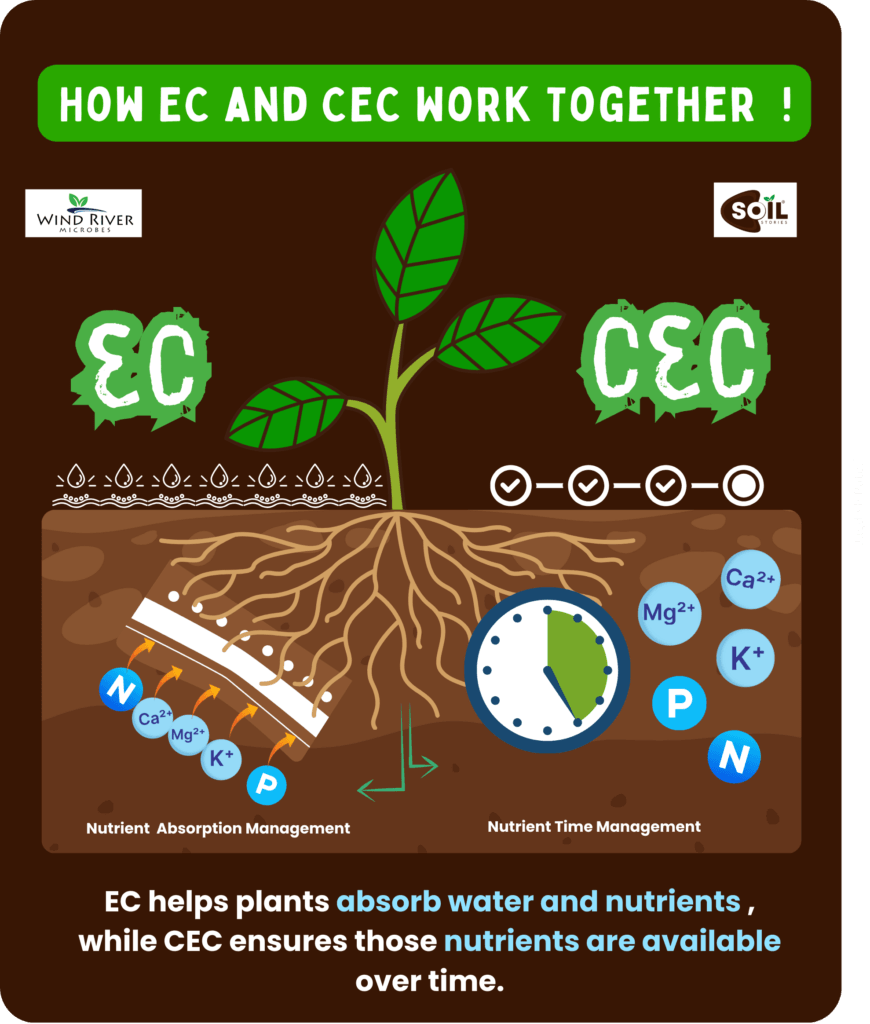
A practical analogy:
- EC is nutrient availability right now
- CEC is nutrient security over time
Common EC–CEC Scenarios
| EC Status | CEC Status | Outcome in the Field |
|---|---|---|
| High EC | Low CEC | Rapid losses, salt stress, inefficient fertilization |
| Low EC | High CEC | Nutrients stored but poorly mobilized |
| Balanced EC | Balanced CEC | Stable nutrition, efficient uptake, resilient crops |
Balanced soils deliver nutrients when plants need them and protect nutrients when they are not immediately required.
When CEC Becomes a Limitation
High CEC soils are often assumed to be fertile by default, but this is not always true.
Problems arise when:
- Nutrients are held too tightly
- Sodium dominates exchange sites
- Soil structure limits root growth
- Biological activity is weak
In such cases, high CEC becomes nutrient storage without nutrient delivery.
Managing Low CEC Soils
Low CEC soils require precision and patience.
Short-term strategies include:
- Split fertilizer applications
- Careful irrigation scheduling
- Cover crops to capture leached nutrients
Long-term improvement focuses on:
- Building organic matter
- Improving soil aggregation
- Enhancing biological activity
- Introducing stable carbon sources
CEC cannot be corrected in one season, but it can be built steadily over time.
The Bottom Line
EC and CEC are not just soil test values. They describe how soil functions.
- EC controls nutrient movement
- CEC controls nutrient retention
When managed together, they create a soil system that feeds crops consistently, reduces losses, and responds predictably to management. When mismanaged, they quietly limit yield and profitability.
Understanding EC and CEC is not about chasing perfect numbers. It is about restoring balance in how soil stores, releases, and delivers nutrients.
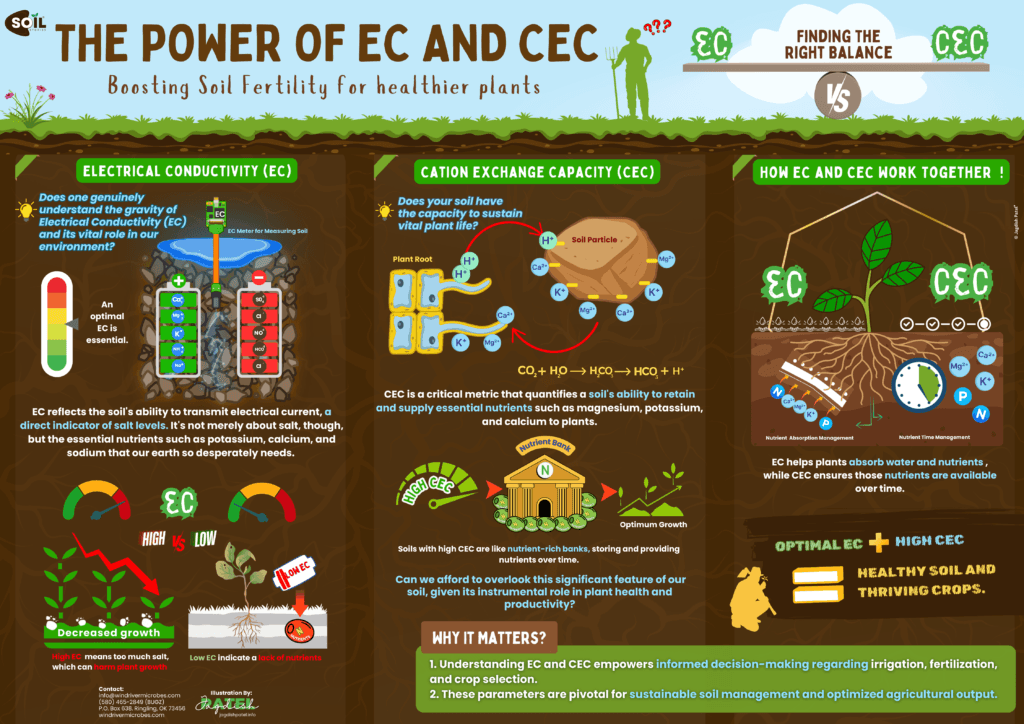
Note:
The illustrations used in this article were created by Jagdish Patel for Wind River Microbes Inc. to visually explain the practical relationship between EC and CEC in soil systems.

This Is the Same Clarity I Bring to Brands.
I’m a soil scientist who turned into a visual science communicator. If this article made a hard concept click, that’s exactly what I build for agriculture and AgTech brands: scientific illustrations, infographics, explainer videos, and content that turns complex research into something your customers actually understand and trust.