A shallow soil moisture sensor reads lower every afternoon of a dry week, which is what anyone would expect. The surprise comes at dawn, when the same sensor reads wetter than it did at dusk even though no rain fell and no irrigation ran overnight. The water came up from the subsoil through the plant’s own roots. Deep roots took it from moist soil, moved it upward through the root system and released it into the dry topsoil while the leaves were inactive. Plant physiologists call this hydraulic lift, and it shows that a root system does more than absorb water, because it also connects soil layers that the soil itself connects only very slowly.
Hydraulic lift depends on the switch between day and night, and it changes what happens to nutrients and microbes in the topsoil. It also has firm limits in a farmed field, and several other ways that water appears in dry soil overnight are easily mistaken for it.
Where hydraulic lift was first measured
In 1987, James Richards and Martyn Caldwell measured soil water potential around big sagebrush (Artemisia tridentata) in the dry rangelands of Utah. The upper soil dried during the day as roots extracted water and then partly recovered every night, with nothing added at the surface. They named the process hydraulic lift in a short paper in Oecologia, and that paper is still the starting point for the subject.
Two years later, Caldwell and Richards traced deuterium-labeled water from deep roots into the upper soil. When they stopped hydraulic lift experimentally, the shrubs transpired 25 to 50 percent less on the following days, which means the water moved overnight was part of the plant’s daily supply. Caldwell, Dawson and Richards (1998) later reviewed reports from trees, shrubs and grasses and concluded that the water lifted in one night can equal an appreciable fraction of a plant’s daily transpiration.
How water moves through a plant during the day
Water moves from higher water potential to lower water potential. During the day, open stomata let water evaporate from the leaves, which drives leaf water potential strongly negative and sets up a continuous gradient from the soil through the root and stem to the leaf and out into the air. Transpiration pulls water up that gradient.
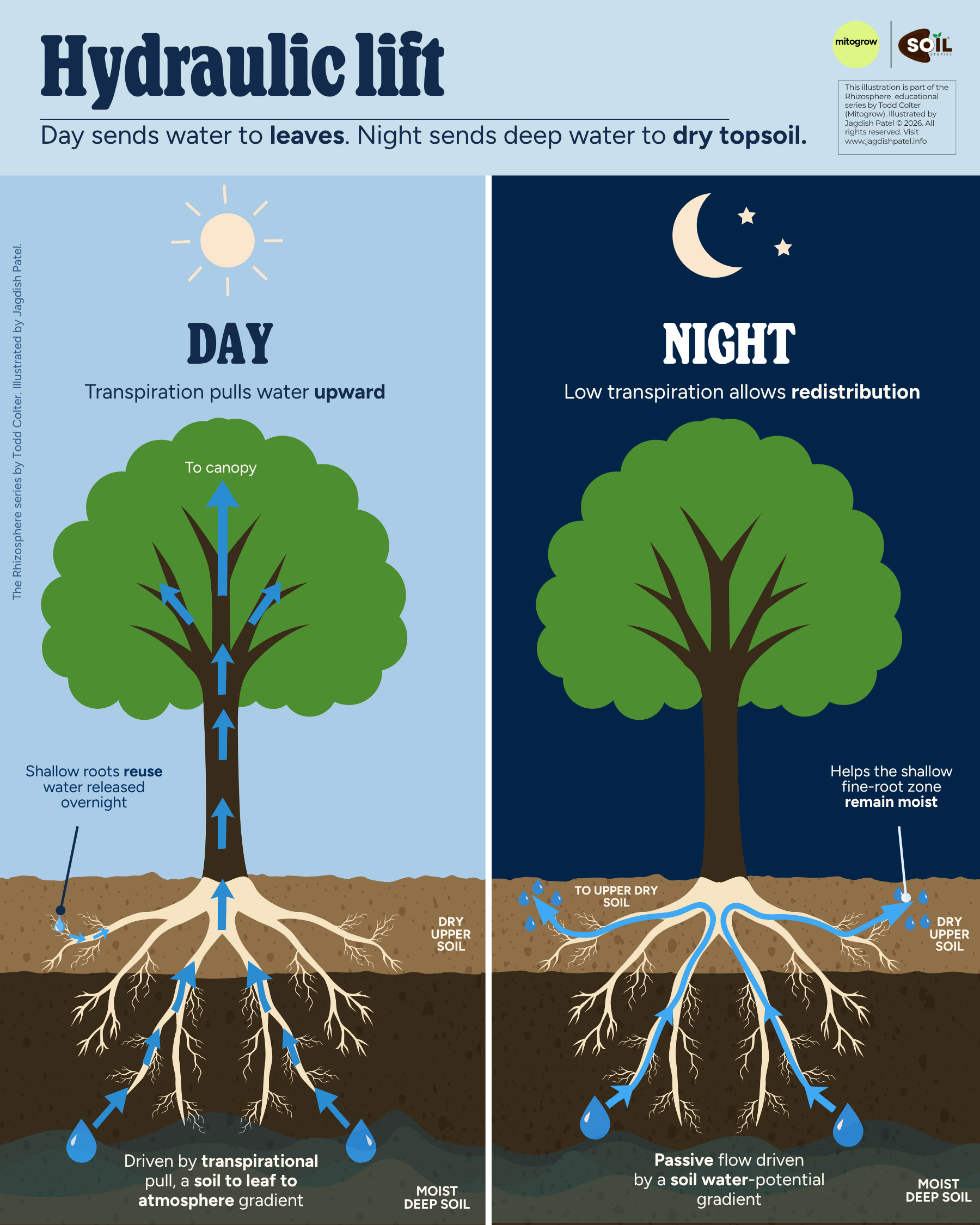
Every root is exposed to the pull, but roots in dry topsoil can extract very little, because the water left there is held tightly on soil particles. Roots in moist subsoil supply most of what the canopy uses, and the day panel of the illustration shows this as upward flow from deep soil to the leaves.
Evaporating that water takes energy, about 2.45 megajoules for every kilogram at ordinary temperatures. The energy comes from the leaf and the air around it, which is why the shade under a transpiring tree is cooler than the shade beside a wall.
What changes at night when stomata close
After sunset most crops and trees close their stomata and transpiration falls sharply. The pull from the canopy collapses, and water potential inside the plant rises toward that of the wettest soil the roots can reach. The pull returns only in the morning, when the leaves start transpiring again.
In the hours between, the root system is a pipe connecting two soil layers at very different water potentials. Deep roots in moist subsoil keep absorbing water, and that water moves through the root xylem to roots in the dry upper soil. Those roots release part of it, since the dry soil now holds water at a lower potential than the root does. By morning, parts of the upper root zone can hold more water than they did the evening before. Once transpiration resumes, the shallow fine roots take much of this water back up, so the plant has in effect moved deep water overnight into the zone where its finest roots and most active microbes live.
Hydraulic lift is passive physics
Hydraulic lift costs the plant no metabolic energy. No pump moves the water, and the plant makes no decision to share it. The flow follows the water potential gradient, and the root works as a low-resistance channel because water travels through a root far faster than it travels through dry soil.
Plant traits still decide how much water moves. Dimorphic root systems, with deep taproots and dense shallow roots, give the strongest connection between layers. Root hydraulic conductance, contact between the root surface and drying soil, and the size of the moisture difference between layers all affect the volume released. Nighttime transpiration works against hydraulic lift, and researchers who want to stop it in an experiment usually keep the plants lit through the night, which holds the stomata open and lets the canopy keep drawing the water that would otherwise go into the topsoil.
Roots also move water downward and sideways
Roots move water in whichever direction the gradient runs. Burgess and colleagues (1998) used the heat pulse method to measure sap flow in the roots of Grevillea robusta and Eucalyptus camaldulensis. During drought the roots carried water from moist deep soil into dry surface soil, and after rain rewetted the surface the flow reversed and carried water downward. Hydraulic redistribution is the general term for this movement in any direction, and hydraulic lift is its upward case.
Why hydraulic lift matters for nutrients and soil microbes
In most agricultural soils the topsoil holds the bulk of the organic matter, fine roots and microbial biomass, and it is also the first layer to dry. As it dries, the water films that carry nutrients to roots by diffusion and mass flow thin out and break, decomposition slows and much of the microbial community goes dormant. Nitrogen, phosphorus and potassium can all be present in that layer and still be out of the root’s reach.
Hydraulic lift reverses part of this every night. Armas and colleagues (2012) grew buffalo grass (Bouteloua dactyloides) in two-layer pots under three treatments: both layers watered, only the lower layer watered, and only the lower layer watered under continuous light to suppress hydraulic lift. Decomposition with hydraulic lift ran at about the same rate as in fully watered pots and was slower where hydraulic lift was suppressed. Plants with hydraulic lift also produced more aboveground biomass and took up more labeled nitrogen. This was a pot trial, but the direction of the result is clear, because water moved by roots kept nutrient turnover going in soil that would otherwise have been too dry for it.
The organisms that release nutrients need the same water. Bacteria, protozoa and nematodes move and feed in water films, so the grazing steps of the soil food web and the wider work of active soil biology slow down in dry soil. Exchanges between roots and microbes, including the rhizophagy cycle and many steps of plant-microbe nitrogen cycling, also run on a moist rhizosphere. Hydraulic lift adds no nutrients of its own, but it keeps the biology that releases them working through a dry spell.
Who else uses the lifted water
Water released into the topsoil is available to anything with roots or hyphae nearby. Dawson (1993) studied mature sugar maples (Acer saccharum) during drought and found that shallow-rooted neighbors close to the trees used hydraulically lifted water, with the effect fading over a few meters. In agroforestry, mixed plantings and cover crop systems that can help a companion species, and it can help a weed growing in the same spot just as easily.
Mycorrhizal fungi take a share as well. Querejeta, Egerton-Warburton and Allen (2003) showed that oaks passed water at night directly to their mycorrhizal fungi during severe soil drying, which kept the hyphae functioning in dry soil. The same group later found (2007) that common mycorrhizal networks offer a potential route for lifted water to move from one plant to another. That ties hydraulic lift to the mycorrhizal hyphosphere, the zone around fungal hyphae where much of the nutrient trade between soil, fungi and roots happens.
Dew, fog and moisture under stones are separate processes
Other sources can wet the soil surface overnight, and on a moisture probe they look the same as hydraulic lift. A dense canopy, especially a cover crop, keeps the air humid near the ground and cuts evaporation from the soil surface, and on cool nights vapor condenses as dew on leaves and soil. Some species absorb small amounts of water through their leaves in fog or dew, which is called foliar water uptake. In both cases the water comes from the air, whereas in hydraulic lift it comes from the subsoil and travels through living roots.
Stones and dark mulch laid beside young trees often keep moist soil underneath them. Part of the reason is reduced evaporation, and the rest is water vapor moving through the soil toward cooler zones and condensing there as the surface cools at night. This vapor flux is soil physics, and the plant plays no part in it.
What limits hydraulic lift in a crop field
Hydraulic lift needs roots in moist soil, a real moisture difference between deep and shallow layers, and low transpiration at night. Roots reaching moist soil is the condition most often missing. Compaction layers, plow pans and restrictive subsoil horizons all stop roots short, and so does a naturally shallow root system. A root that never reaches wet subsoil has nothing to lift, so a restrictive layer costs the crop twice, once in deep water uptake and again in the redistribution that depends on it.
The moisture difference depends on rain and soil. After a soaking rain the whole profile is wet, and late in a long drought it can be dry all the way down, and neither state gives hydraulic lift a gradient to work with. It runs strongest between the two, once the surface has dried and the subsoil still holds water. Night weather controls the last condition, because warm, dry and windy nights keep evaporative demand high, and plants that keep transpiring at night hold more deep water in the canopy and release less of it into the topsoil.
Nutrition affects it as well. In a greenhouse study with winter wheat, Shen, Zhang and Li (2011) found that nitrogen and phosphorus applied together produced the largest hydraulic lift across the growth period, compared with either nutrient alone or no fertilizer. Correcting deficiencies that restrict root growth is therefore part of managing for hydraulic lift, although the wheat result came from pots and has not been tested this way in the field.
What hydraulic lift cannot do
Hydraulic lift moves water around the profile and adds none. Every liter released into the topsoil was taken from the subsoil first, so hydraulic lift can delay drought stress but cannot replace rain or irrigation once deep reserves run out. The same plant reabsorbs much of the lifted water the next day, so the net gain for the field is smaller than the overnight rise on a moisture probe suggests.
Most measurements come from deep-rooted perennials, desert shrubs, trees and pot experiments. Annual crops have younger and shallower roots, and hydraulic lift in field-grown row crops is far less documented. Any claim that a product switches on hydraulic lift should be checked against that evidence. Management can remove the barriers that keep roots out of moist subsoil and protect the topsoil conditions that let redistributed water do useful work, and that is about as far as the evidence goes.
What hydraulic lift means for agronomists and growers
A shallow probe that reads wetter at dawn with no rain, irrigation or heavy dew may be recording hydraulic lift and not a fault. The effect is most likely under deep-rooted perennials, orchards and cover crops during a dry spell, and knowing about it prevents a misread when irrigation is being scheduled.
Anything that helps roots go deeper helps hydraulic lift. In practice that means breaking or avoiding compaction layers, keeping traffic off wet soil, correcting nutrient deficiencies and putting deep-rooted cover crops, perennials or trees into the system. Residue cover and a living canopy then cut evaporation, so more of the water released overnight is still there for roots and microbes the next day.
Deep roots are usually justified by the water they reach in a drought. Hydraulic lift gives a second reason, because a deep root also changes where water is available in the profile, and it can rewet the upper root zone every night while the field is quiet.
About the illustration
The hydraulic lift illustration in this article was created for MitoGrow Pro as part of The Rhizosphere Series by Todd Colter, an educational series on root zone science. If your company needs its product science explained visually in the same way, connect with me.
Sources
Richards, J.H., and Caldwell, M.M. (1987). Hydraulic lift: substantial nocturnal transport of water between soil layers by Artemisia tridentata roots. Oecologia, 73, 486-489.
Caldwell, M.M., and Richards, J.H. (1989). Hydraulic lift: water efflux from upper roots improves effectiveness of water uptake by deep roots. Oecologia, 79, 1-5.
Dawson, T.E. (1993). Hydraulic lift and water use by plants: implications for water balance, performance and plant-plant interactions. Oecologia, 95(4), 565-574.
Caldwell, M.M., Dawson, T.E., and Richards, J.H. (1998). Hydraulic lift: consequences of water efflux from the roots of plants. Oecologia, 113, 151-161.
Burgess, S.S.O., Adams, M.A., Turner, N.C., and Ong, C.K. (1998). The redistribution of soil water by tree root systems. Oecologia, 115(3), 306-311.
Querejeta, J.I., Egerton-Warburton, L.M., and Allen, M.F. (2003). Direct nocturnal water transfer from oaks to their mycorrhizal symbionts during severe soil drying. Oecologia, 134(1), 55-64.
Egerton-Warburton, L.M., Querejeta, J.I., and Allen, M.F. (2007). Common mycorrhizal networks provide a potential pathway for the transfer of hydraulically lifted water between plants. Journal of Experimental Botany, 58(6), 1473-1483.
Shen, Y., Zhang, Y., and Li, S. (2011). Nutrient effects on diurnal variation and magnitude of hydraulic lift in winter wheat. Agricultural Water Management, 98(10), 1589-1594.
Armas, C., Kim, J.H., Bleby, T.M., and Jackson, R.B. (2012). The effect of hydraulic lift on organic matter decomposition, soil nitrogen cycling, and nitrogen acquisition by a grass species. Oecologia, 168, 11-22.

This is the same clarity I bring to brands.
I’m a soil scientist who turned into a visual science communicator. If this article made a hard concept click, that’s exactly what I build for agriculture and AgTech brands: scientific illustrations, infographics, explainer videos, and content that turns complex research into something your customers actually understand and trust.