
Soil water holding capacity is one of the most important and most misunderstood properties in soil science. Most conversations around it start and end with texture. Sand, silt, clay. It is a familiar framework, easy to measure and easy to compare. But here is the deeper reality: two soils with the same texture can behave very differently when it comes to holding water. So what is really controlling it? The answer sits below the surface, in something we do not always measure directly. Soil structure, and more importantly, how that structure is built.
“Water retention is not just a physical property. It is a biological outcome, one that reflects the health and activity of everything living below the surface.”
Soil does not just hold water. It organizes it.
Water in soil is not simply stored in empty spaces. It is held within a dynamic, biologically structured system that is constantly being shaped by plant roots, microbial activity, soil fauna, and organic compounds moving through the rhizosphere. The distinction matters because it changes the entire way we approach soil management. If water retention is a biological outcome, then improving it requires supporting the biology that builds and maintains structure, not simply amending soil composition.
The missing link: Structure over composition
For decades, improving water holding capacity has been associated with increasing soil organic matter, improving texture, and reducing compaction. All valid approaches. But recent research shows something more nuanced. In a study comparing Miscanthus giganteus with maize, soil water holding capacity increased by nearly 15% within just a few growing seasons. Interestingly, soil organic carbon did not significantly change and total porosity remained similar, yet water retention improved. Why? Because soil structure changed. Not composition. Not chemistry. Structure. This distinction carries real weight for how we approach soil management, and it connects directly to what we explored in Organic matter vs organic fertilizer: why soil listens to biology, not branding, where resilience is shown to come from what the soil has lived through, not what has been applied to it.
Same texture. Different behaviour. Why?
This table illustrates how two soils with identical texture can perform very differently depending on biological structure.
| Soil property | Biologically active soil | Biologically depleted soil |
|---|---|---|
| Texture | Same (e.g. loam) | Same (e.g. loam) |
| Aggregate stability | High, stable micro and macro aggregates | Low, particles disperse easily |
| Water retention | Higher, pore structure holds water longer | Lower, water drains or evaporates faster |
| Microbial activity | Active, EPS produced, aggregates reinforced | Low, no biological binding agents present |
| Recovery after drought | Faster, structure intact, biology rebounds | Slower, compaction worsens, crusting forms |
| Root development | Deeper, denser, more branched | Shallow, restricted, less fibrous |
How plants actively build soil structure
Plants are not passive occupants of soil. They are active engineers. As they grow, they reshape the soil environment through two interconnected pathways: direct physical interactions driven by roots, and indirect biological processes driven by the microbial communities that roots recruit and sustain.
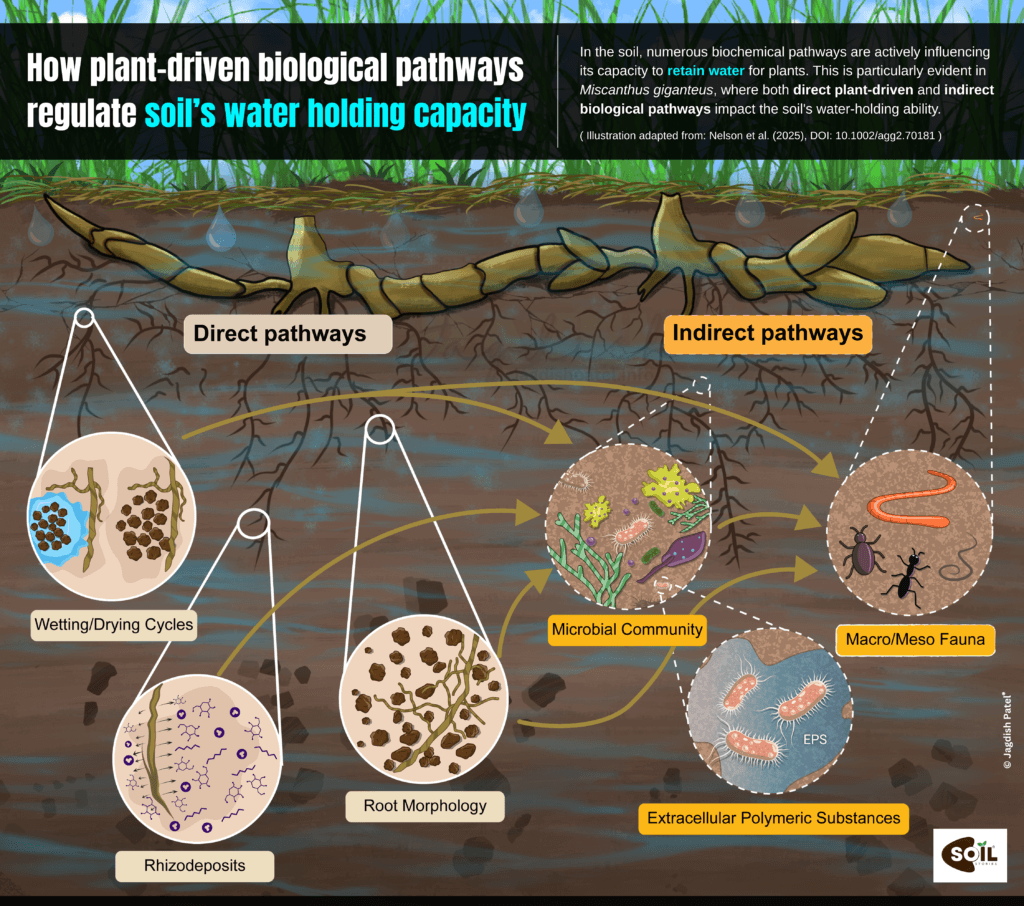
Two pathways. One outcome.
Direct pathways involve root-driven physical restructuring of soil through wetting and drying cycles, rhizodeposits, and root architecture. Indirect pathways involve biology, the microbial communities, extracellular compounds, and soil fauna that refine and stabilize the structure roots create. Together, these two pathways determine how soil holds water.
1. Direct pathways: Physical restructuring by roots
Root-driven wetting and drying cycles
Roots constantly absorb water and release it, creating micro-scale wetting and drying cycles in the soil. Over time, these cycles rearrange soil particles, improve aggregation, and increase structural stability. This is one of the most underappreciated mechanisms of soil formation, operating quietly beneath every plant that grows and contributing to structure long before organic matter accumulates at measurable levels.
Rhizodeposits as natural binding agents
Roots release a wide range of compounds into the soil, including sugars, organic acids, and mucilage. These compounds act as biological adhesives, helping soil particles bind together into stable aggregates that resist dispersion and retain water more effectively. The biology triggered by these exudates is explored in depth in the article on Phosphate solubilizing bacteria, which illustrates how root-released compounds set off cascading biological activity across the entire rhizosphere zone.
Root architecture and soil stability
Not all roots behave the same way. Dense, fibrous root systems create more contact points between soil particles, resulting in better particle binding and higher aggregate stability. Over time, this builds a soil structure that can hold and distribute water far more effectively than soils shaped by coarser or less branched root systems.
2. Indirect pathways: Biology as the real architect
If roots are the builders, biology is the system that continuously refines the structure they create. And the scale of this biological activity is easy to underestimate.
Microbial community shifts
Root exudates do not just feed plants, they feed microbes. Different plants support different microbial communities, and these communities influence aggregation, modify pore structure, and affect water dynamics across the soil profile. As covered in Microbes at work: how soil life feeds your plants naturally, a single teaspoon of healthy soil can host more than a billion microorganisms, each playing a specific role in how that soil functions. Microbes, in a very real sense, decide how soil behaves.
Extracellular polymeric substances (EPS)
Certain microbes produce substances known as EPS, a gel-like matrix that binds soil particles, retains moisture, and creates microenvironments that actively resist drying. This is one of the key reasons biologically active soils retain water better than chemically similar but biologically depleted counterparts. The role of the rhizosphere as the engine of this activity is detailed in Soil microbes: the hidden engine of sustainable farming, which also explores how advances in delivery technology are now making it possible to place these organisms precisely where they have the most impact. According to the USDA Natural Resources Conservation Service
, soil biological activity is one of the primary drivers of aggregate stability and long-term water retention capacity.”
“EPS-producing microbes create a gel-like matrix inside soil that binds particles, holds moisture, and resists drying. Biology is the most reliable water retention technology available.”
Soil fauna: The physical engineers
Earthworms, insects, and other soil organisms play a major physical role. They create channels, mix organic matter, improve aeration, and enhance aggregation. Their activity transforms soil from a static medium into a living, self-regulating structure capable of responding to both rainfall and drought. Without this fauna, even a biologically rich topsoil can lose its structural integrity over time.
What this means for real-world soil systems
This shifts the entire way we think about water in soil. It is not just about how much water enters or how much water leaves. It is about how the soil system holds and organizes that water. Two soils can receive the same rainfall, but the one with better biological structure will retain more water, supply it more efficiently to plants, and recover faster under stress. This principle applies whether you are managing a native landscape installation, a transplanted shrub bed, or compacted turf under heavy use.
Why this matters more than ever
Climate variability is increasing. Rainfall is becoming less predictable and dry periods are getting longer. In this context, soil water holding capacity becomes critical infrastructure, not just an agronomic metric. But simply adding inputs will not solve the problem, because inputs do not control structure. Biological systems do. Improving water retention requires activating and supporting the biology that builds structure, not just amending composition.
Rethinking soil management
If structure drives water retention, then the management focus shifts fundamentally. The priority becomes maintaining continuous plant cover, supporting root diversity across the profile, encouraging microbial activity through minimal disturbance, and reducing unnecessary tillage and compaction events. This is not about adding more. It is about enabling the system to function. When the system functions, structure follows, and when structure improves, water retention improves with it.
“The capacity of any given soil to retain water is not fixed by its texture. It is shaped, continuously, by the living systems within it.”
The real question
We often ask how much water a soil can hold. But the better question is whether that soil is biologically structured to retain water effectively. Because that is where the real difference lies. Texture sets the boundary. Biology determines what happens within it.
We understand more about soil than we communicate. Much of what happens below the surface remains invisible in everyday decision-making. Bringing these processes into view changes how we think, manage, and design systems and ultimately, how soil performs. The soil is not waiting for better inputs. It is waiting for better conditions.

This Is the Same Clarity I Bring to Brands.
I’m a soil scientist who turned into a visual science communicator. If this article made a hard concept click, that’s exactly what I build for agriculture and AgTech brands: scientific illustrations, infographics, explainer videos, and content that turns complex research into something your customers actually understand and trust.